
Key Takeaways
- For growing firms, the challenge with model portfolios is not only choosing an allocation approach, but creating the operational consistency to deploy, personalize, and communicate that approach at scale.
- The choice to build proprietary models, adopt third-party strategist models, or combine both has downstream implications for differentiation, fees, operating capacity, and growth strategy.
- Model portfolio management depends on more than the models themselves. Consistent implementation also relies on documented governance, clear personalization boundaries, and repeatable workflows.
- Advisor overlays, meaning client-specific adjustments to a standard model allocation, help firms personalize advice for tax considerations, investment restrictions, and concentrated positions.
- A defined model framework can support more consistent prospect analysis by giving advisors a structured baseline for current-versus-proposed comparisons across risk, diversification, fees, and taxes.
For growing wealth management firms, the challenge isn't simply selecting the right model portfolios. It's creating the operational consistency to deploy, personalize, and communicate those models at scale.
That is why the conversation around model portfolios for financial advisors is broader than investment selection alone. The more consequential questions are often operational: how the models are governed, how advisors apply client-specific adjustments, how proposed changes are communicated, and how the firm maintains consistency across custodians and teams. From that perspective, a model is a starting framework, while the surrounding workflows determine how consistently it is put into practice.
This article examines the practical decisions firms face when building and managing model portfolios as a firm capability. It explores how firms evaluate build, adopt, or hybrid approaches; how model portfolio management connects to governance and personalization; how RIA model portfolios can support prospect acquisition; and what model portfolio implementation can look like across more complex operating environments.
This content is for informational purposes only and should not be considered investment, legal, or compliance advice. Your firm's specific circumstances may vary.
What Model Portfolios Actually Solve for Advisory Firms
Model portfolios are often described as an investment management tool, a way to implement a CIO's asset allocation views consistently. That is true at the investment level, but for advisory firms the bigger question is what the model does on its own, and what depends on the surrounding infrastructure. A model provides a standardized investment framework. It does not, by itself, create firmwide governance, operational visibility, or consistent execution.
Those broader benefits depend on the technology, policies, and workflows that surround the model. Firms still need a way to assign models to households, monitor for drift, document changes, review exceptions, and communicate differences between the standard model and the client account. In that sense, model portfolio management is not just about defining an allocation. It is also about building the operating discipline to implement and monitor that allocation consistently.
Consider a hypothetical growing RIA with eight advisors. If each advisor builds portfolios from scratch for every client, the firm might soon be managing hundreds of unique allocations. This ad hoc approach can lead to inconsistent risk exposures across similar households, limited visibility into what is actually being recommended, and a heavier monitoring burden. By contrast, a defined set of models gives the firm a shared starting point. Advisors still retain room to personalize, but they begin from a common framework rather than from a blank page each time.
The distinction matters. Models can standardize the investment framework, but the consistency firms want from RIA model portfolios comes from the combination of the model and the infrastructure around it.
Read more: Operational Visibility for Wealth Management Growth | VRGL
Building Firm-Owned Models, Adopting Third-Party Strategist Models, or Combining Both
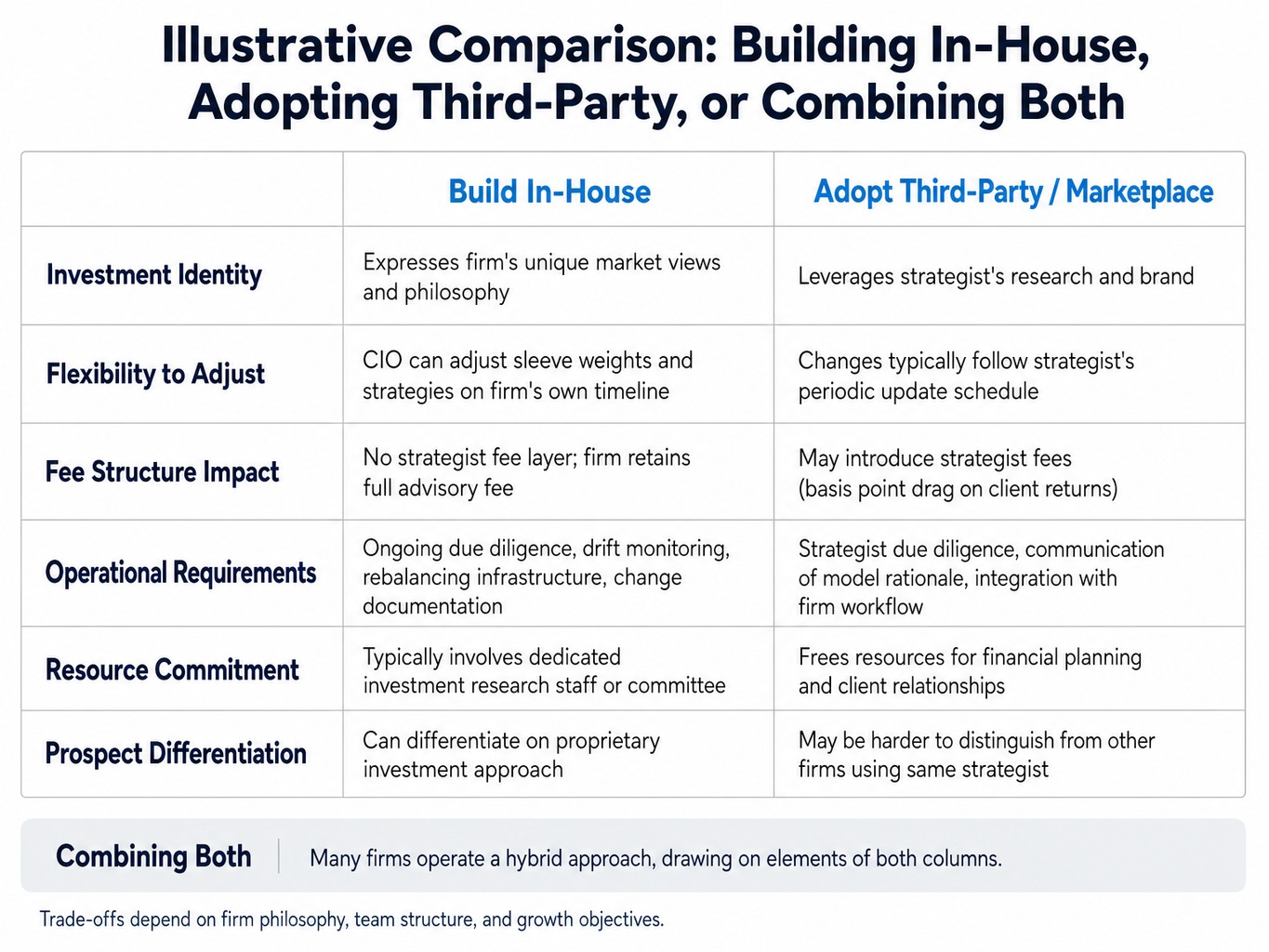
Many advisory firms eventually face a decision about whether to build proprietary models in-house or adopt models from a third-party strategist, model marketplace, or TAMP. Many also use a hybrid approach. The right path often depends on a few practical criteria: the firm's internal investment resources, how much differentiation it wants in the marketplace, its operational capacity to maintain models over time, the fee structure it wants to support, and its broader growth strategy. Framed this way, the question is not only which models to use, but which operating approach the firm can sustain.
When Building In-House Models May Make Sense
Building in-house may fit firms that have a defined investment philosophy, dedicated investment leadership, and the capacity to maintain models over time. For these firms, proprietary models can be a way to express a distinct market view and create tighter alignment between the firm's investment approach and its client communication.
That flexibility comes with a larger operating commitment. A firm-managed model program generally calls for ongoing research, documented review processes, drift monitoring, rebalancing capabilities, and clear communication when changes are made. For leadership teams, the question is not only whether they can design the models, but whether they want to own the full model portfolio implementation process that follows.
When Third-Party or Marketplace Models May Fit Better
Third-party strategist models may fit firms that want to expand model usage without building a full internal investment research function. They can also appeal to firms whose growth strategy emphasizes advisor capacity, financial planning depth, or faster adoption across a broader advisor base. In those cases, the trade-off may be less control over the underlying investment framework in exchange for less internal maintenance.
The operational work does not disappear, however. Firms still need to evaluate the strategist, understand how the models fit their client base, account for any fee implications, and explain the differences between a prospect's current portfolio and the proposed model. In practice, that means executive teams are often evaluating not just an investment option, but a delivery model: how much differentiation they want, how much internal complexity they are prepared to absorb, and where they want advisors spending time as the firm grows.
Governance Structures That Support Model Portfolio Management
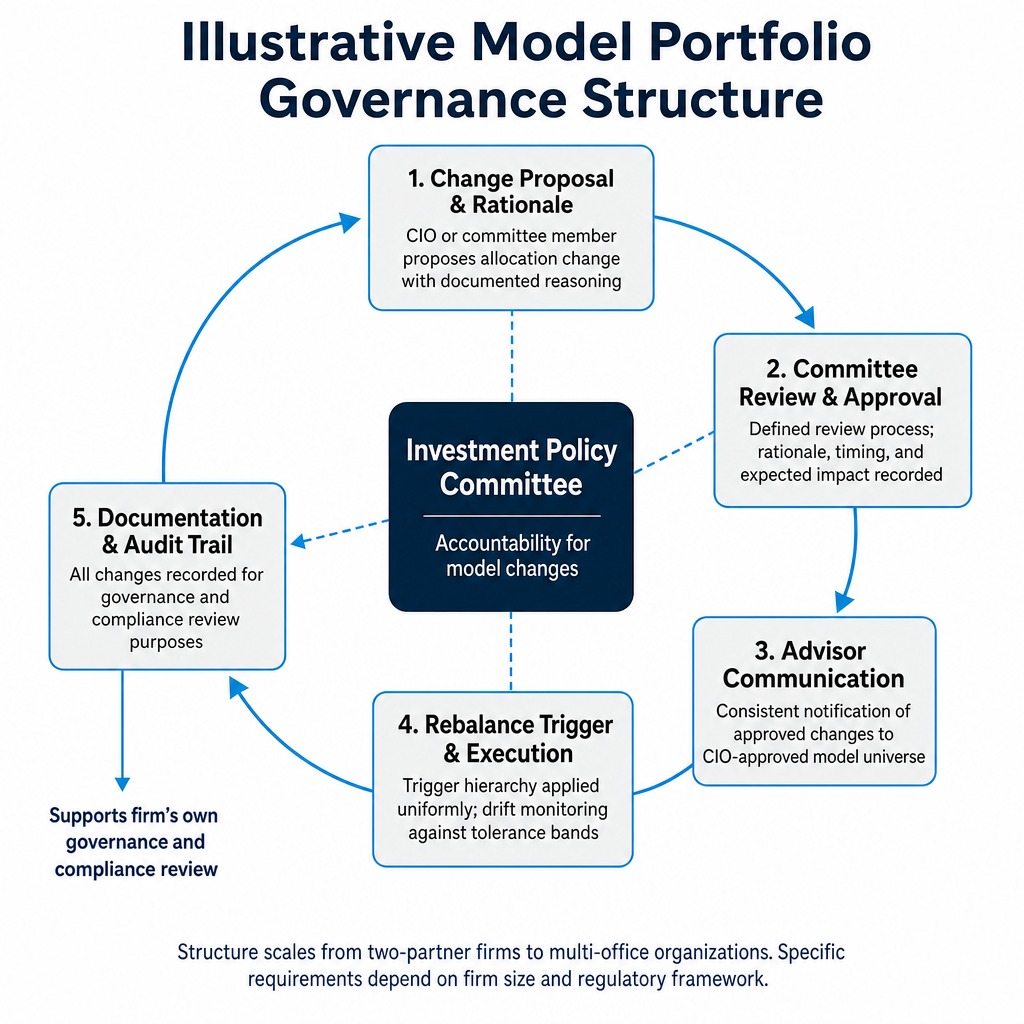
A list of model allocations, on its own, offers limited structure. Consistency tends to depend on the firm having defined who can change models, how changes are documented, how advisors are notified, and what review process applies before changes reach client accounts. Governance in this sense functions as a mechanism that can help a firm scale its investment process with accountability and a clear record of how decisions were made. The right structure depends on the firm's size, regulatory posture, and organizational complexity.
Investment Policy Committee and Change Documentation
A defined investment policy committee, even if it is just two partners at a small firm, creates accountability for model changes and produces documentation that can support internal review. Consider a firm where the CIO proposes a change to the methodology behind an equity sleeve. Without a governance process, that change might be implemented inconsistently across advisors or not at all. With a documented committee review, the rationale, timing, and expected impact can be recorded clearly. Advisors can then receive a consistent communication about the approved change to the firm's model lineup, and the firm's rebalancing and monitoring rules can be applied more uniformly.
Scaling Governance Across Multiple Advisors and Offices
Governance becomes more complex as firms add advisors, offices, or acquired practices. For a multi-office firm seeking to establish a shared model lineup, the challenge is creating firmwide investment governance without forcing every advisor to abandon their existing approach immediately. One important element is visibility into what models are being used, where deviations exist, and whether those deviations reflect approved personalization or simple drift.
That is where the surrounding operating framework matters. Firms typically need a way to track which households are linked to which models, monitor whether client accounts still align with the intended allocation, and document when an advisor has made a client-specific adjustment. At scale, governance tends to rely on both policy and infrastructure: the rules that define the process, and the systems that help the firm monitor it consistently.
Read more: RIA Practice Management That Scales: A Workflow-First Approach for Growing Firms | VRGL
How the Advisor Overlay Layer Supports Portfolio Personalization
Model portfolios can create a tension between firmwide consistency and client-specific personalization. An advisor overlay is a client-specific adjustment to a firm's standard model allocation. It is one way firms can balance that tension. While a model provides the baseline asset allocation framework, individual clients may have circumstances that warrant adjustments, such as concentrated stock positions , tax considerations, or specific investment restrictions.
These overlays matter because they help advisors connect a standard framework to a client's actual situation. They can reflect legacy holdings, account-level restrictions, or a need to phase in changes over time. They also give firms a more practical way to personalize within a model-based approach, rather than treating every client as either a perfect fit for the model or a fully custom portfolio.
Imagine a hypothetical high-net-worth household with a large concentrated stock position. The firm's growth model may call for broader equity diversification, but the household's circumstances may warrant a different implementation path. In that situation, the overlay is where the advisor applies judgment to adapt the standard allocation, document the reason for the adjustment, and show how the client's portfolio differs from the base model. The overlay layer is best understood as a deliberate design feature of model portfolio management, one that can support portfolio personalization at scale.
Connecting Model Portfolios to the Prospect Acquisition Workflow
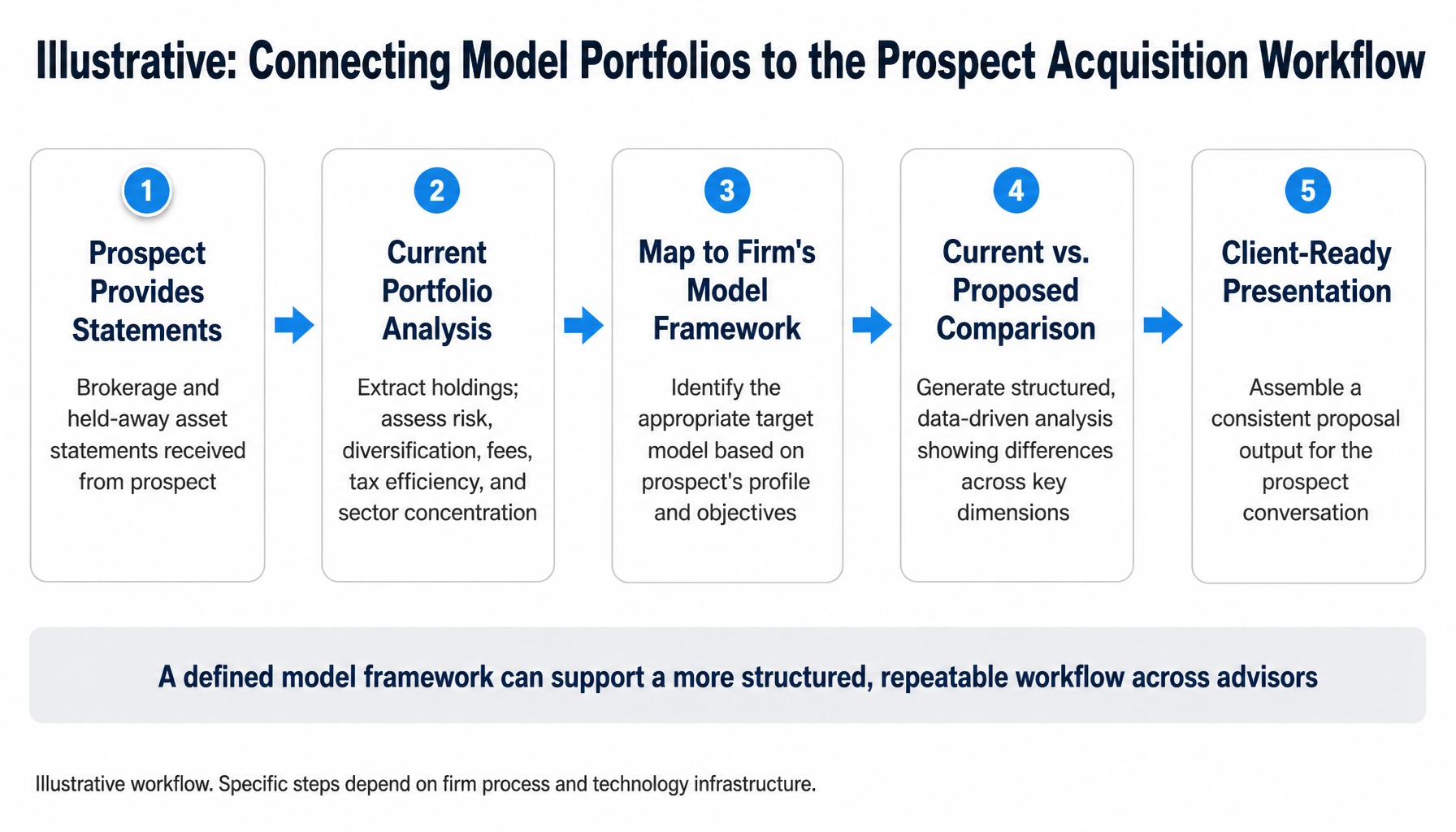
While model portfolios are typically discussed as a portfolio management tool, they can also play an important role in the prospect acquisition conversation. Once the firm's discovery and fact-finding process has captured a prospect's goals and constraints, and the prospect has provided statements from their current advisor, the next step is often to analyze that existing portfolio against the firm's model framework. This is where a standardized approach becomes especially valuable.
If the firm has a defined model framework, the advisor starts from a known baseline rather than building every recommendation from scratch. That baseline can make it easier to identify where the prospect's current allocation differs from the proposed approach across risk, diversification, fees, taxes, and concentration. It also gives the advisor a clearer way to communicate what would actually change, why those differences matter, and how the recommendation fits within the firm's broader investment approach.
For instance, imagine an advisor receives a hypothetical prospect's brokerage statements revealing a portfolio with high expense ratios, heavy sector concentration, and minimal international exposure. With a defined model as the comparison point, the advisor can produce a current-versus-proposed analysis that highlights those gaps in a more structured way. That comparison can help the advisor show where there may be opportunities to improve diversification, reduce overlapping exposures, or simplify the portfolio's overall construction, while also evaluating transition considerations before any recommendation is implemented.
This is one of the more commercially important aspects of model portfolio implementation. A firm with a standardized framework is often better positioned to deliver a more consistent analytical story in prospect conversations, not because the model determines the recommendation, but because it gives advisors a repeatable way to compare, explain, and present their point of view.
Deployment Considerations for Multi-Custodian and Multi-Office Firms
Deploying model portfolios becomes operationally more complex when a firm works across multiple custodians or operates from multiple offices, a reality for many growing RIAs and enterprise wealth firms . This is as much a governance and workflow design challenge as a technology problem, and it can benefit from deliberate planning.
Several practical challenges can arise. Differences in supported securities, available investment vehicles, platform restrictions, trading capabilities, and rebalancing systems can all affect how a model is implemented from one custodian to another. Even when the target allocation is the same, the path to implementation may vary across platforms. This can make it difficult to maintain a single, consistent view of model adherence across the firm.
Consider a firm that custodies with two platforms after an acquisition. The same model may need to be implemented with slightly different underlying holdings or account structures on each platform. If the advisors in the acquired office use different rebalancing tools or follow different trading workflows, a gap can emerge between the firm's intended model and what is actually in client accounts. This is one reason some firms develop an operational scalability plan that accounts for multi-custodian model portfolio implementation before the models go live.
How VRGL Supports the Workflows Surrounding Model Portfolio Decisions
As this article has discussed, model portfolios become more useful when firms can analyze existing portfolios, compare them against a proposed framework, and present that analysis clearly in client and prospect conversations. Those are distinct from the governance, rebalancing, drift monitoring, overlay administration, and multi-custodian implementation processes that firms may manage through other systems, policies, and teams.
This is where the VRGL Growth Platform becomes relevant. VRGL is not a platform that builds or manages models. Instead, it supports the analytical workflow around model portfolio decisions: reviewing a current portfolio, comparing it against a proposed model, evaluating transition considerations such as risk, diversification, taxes, and fees, and producing client-ready proposals that help advisors communicate their own recommendations more clearly.
This helps firms establish a more consistent approach to portfolio analysis and client presentations across their advisor teams. Proposal output is one part of that workflow, giving firms a way to present portfolio comparisons in a client-ready format that supports a shared analytical and presentation baseline across advisors.
See how VRGL supports your acquisition workflow
Conclusion
The decision to implement model portfolios is partly an investment decision, but it is also a business and operating decision. The choice between building proprietary models, adopting third-party versions, or combining both shapes how a firm organizes investment oversight, personalization, and client communication.
For growing firms, the bigger opportunity is not simply creating allocations. It is building a model portfolio management approach that advisors can apply consistently, explain clearly, and adapt to real client circumstances. When that foundation is in place, firms are often better positioned to deliver a more consistent investment experience, communicate their value more effectively, and support organic growth without adding operational complexity at the same pace.
Frequently Asked Questions
What is the difference between a model portfolio and a separately managed account for advisory firms?
A model portfolio is a defined investment strategy or allocation framework that can be applied across accounts. A separately managed account, or SMA, is an individually managed investment account in which the investor directly owns the underlying securities. The two are not mutually exclusive. For example, a firm may use a model portfolio as the strategic framework within an SMA structure.
How does drift monitoring work within a model portfolio management workflow?
Drift monitoring tracks how far an account's actual allocation has moved from the target model. Firms may define tolerance bands, for example a hypothetical 3 to 5 percent deviation, that prompt a rebalancing review. The operational question is how those reviews are timed, documented, and applied consistently across accounts within the firm's own governance process.
What operational challenges commonly arise when an RIA transitions from ad hoc portfolio management to a model-based approach?
Common challenges include reconciling existing client portfolios that do not match a proposed model, evaluating transition considerations related to taxes, fees, or legacy holdings, and gaining buy-in from advisors who are accustomed to building portfolios independently. In many cases, the transition begins with new accounts and expands gradually as the firm develops a more consistent model portfolio implementation process.